
 by
by 

One of the most common questions we hear is also one of the most personal: Should I keep renting, or is it time to buy?
There is no honest one-size-fits-all answer. Renting can be the smarter choice when flexibility matters most, your plans are still changing, or buying would leave you financially stretched. Buying can make sense when you expect to stay in the area, want more control over your home, and are prepared for both the upfront and ongoing responsibilities of ownership.
The right decision is not based on whether renting is ‘throwing money away’ or whether buying is always a good investment. It comes down to your timeline, financial readiness, lifestyle, and the specific Charlotte neighborhoods and properties you are considering.
Start With the Question Behind the Question
Most people are not simply comparing a rent payment with a mortgage payment. They are deciding how much stability they want, how much responsibility they are ready to carry, and how certain they are about the next several years.
Before you compare numbers, ask yourself a few practical questions: How long do I expect to stay in the Charlotte area? Is my job or household likely to change? Do I want the freedom to move quickly? Am I prepared for repairs and maintenance? Would buying still leave me with adequate savings after closing?
Those answers often point more clearly toward renting or buying than a generic market headline ever could.
When Renting May Be the Better Choice
Renting is not a failure to move forward. In the right circumstances, it is a deliberate financial and lifestyle decision.
You need flexibility. Renting can work well when you may relocate, change jobs, combine households, or move to a different part of Charlotte within the next few years. A lease usually gives you a clearer exit than homeownership.
You are still learning the area. Charlotte is not one uniform market. Living in Uptown, South End, Ballantyne, Matthews, Huntersville, or South Charlotte can create very different commute patterns and daily routines. Renting first can help you learn what actually fits before making a long-term commitment.
Buying would use most of your savings. A down payment is only part of the cash needed to buy. Buyers should also plan for closing costs, inspections, moving expenses, due diligence and earnest money, and reserves for repairs after closing.
You do not want maintenance responsibility. Renters generally rely on the property owner for many major repairs. Homeowners are responsible for the roof, HVAC system, plumbing, appliances, landscaping, and other costs that arrive on their own schedule.
Your monthly budget is already tight. A lender may approve a payment that is higher than what feels comfortable in real life. Renting may be the better temporary choice if buying would make it difficult to save, handle emergencies, or meet other financial goals.
What Renting Does Not Provide
Renting offers flexibility, but it also comes with limits. Rent may increase at renewal. The owner may decide to sell. You may face restrictions on pets, renovations, painting, landscaping, or how long you can remain in the property.
Rent payments also do not create ownership in the property. That does not make rent wasted money; it pays for housing and flexibility. But it does mean you are not building home equity through those payments.
When Buying May Be the Better Choice
Buying may be worth considering when your plans and finances are stable enough to support the full responsibility of ownership.
You expect to stay for several years. Buying and later selling involve costs. A longer ownership period can give you more time to absorb those expenses and benefit from principal reduction or possible appreciation, although no future value is guaranteed.
You want more control over your living space. Homeownership usually gives you greater freedom to renovate, decorate, landscape, and use the property within local rules, HOA restrictions, and permit requirements.
You have stable income and sufficient reserves. A responsible buying plan accounts for the down payment, closing costs, due diligence, inspections, moving expenses, and money left over for repairs and emergencies.
The available homes fit your real budget. The important number is not simply the maximum loan amount. It is the total monthly cost you can carry comfortably after including principal, interest, taxes, insurance, HOA dues, utilities, maintenance, and other recurring expenses.
You are ready for the practical work of ownership. Owning a home can provide stability and pride, but it also means making decisions about repairs, contractors, insurance claims, maintenance, and future improvements.
What Buying Does Not Guarantee
Buying does not guarantee appreciation, tax benefits, or a profit when you sell. Market value can rise, remain flat, or decline, and selling costs affect the amount an owner ultimately receives.
A fixed-rate mortgage can make principal and interest more predictable, but the full payment may still change because property taxes, insurance premiums, HOA dues, or mortgage insurance can change over time. Tax treatment also depends on the homeowner’s individual circumstances and should be discussed with a qualified tax professional.
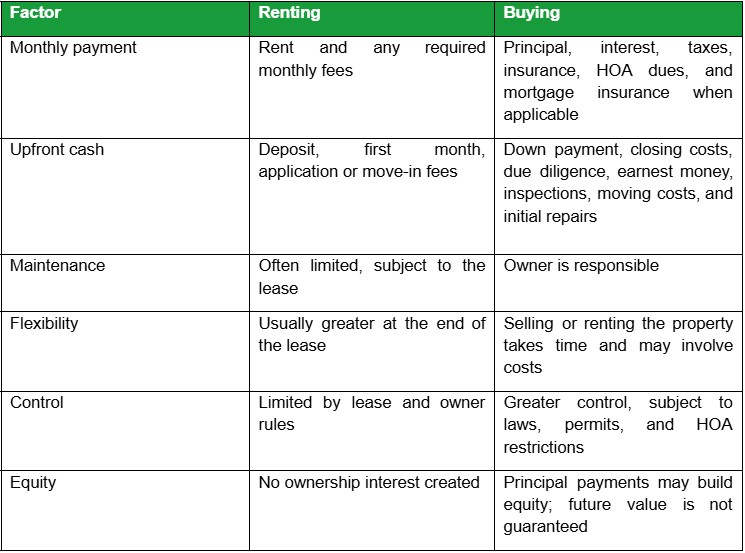
Compare the Full Monthly Cost, Not Just Rent and Mortgage
A useful comparison should place the complete cost of each option side by side.
Use a Break-Even Calculation Carefully
Online rent-versus-buy calculators can be useful, but the result depends entirely on the assumptions entered. Appreciation, rent increases, maintenance, investment returns, selling costs, loan terms, and the length of ownership can all change the outcome.
Treat a calculator as a planning tool, not a verdict. A local lender can help estimate financing costs, and a real estate professional can help compare the actual homes, rents, taxes, HOA expenses, and resale considerations in the areas you are considering.
Charlotte Location Can Change the Answer
The rent-versus-buy decision can look very different from one Charlotte-area location to another. A condominium near Uptown may have a higher HOA cost but reduce commuting time. A suburban home may offer more space but bring longer travel, higher maintenance, or different utility expenses. New construction may include incentives, but buyers still need to compare the builder’s contract, upgrades, lot premiums, taxes, and future neighborhood development.
The decision should be based on the specific property and lifestyle, not a metro-wide average. School assignments, commute times, insurance considerations, HOA rules, planned construction, and neighborhood resale patterns should all be verified before you commit.
A Simple Decision Framework
- Estimate your likely timeline. How long do you reasonably expect to stay in the home or area?
- Set a comfortable monthly limit. Include the complete cost of ownership, not merely the loan payment.
- Calculate the cash needed at closing. Include inspections, due diligence, earnest money, moving expenses, and reserves.
- Compare real properties and rentals. Use actual options in the neighborhoods you would choose, not generalized averages.
- Stress-test the decision. Consider a repair, income change, insurance increase, or earlier-than-planned move.
- Choose representation before shopping seriously. Know whose interests your real estate agent and brokerage represent before sharing financial limits or negotiating strategy.

Why Representation Matters Before You Decide to Buy
A buyer’s agent should do more than open doors. The work begins with helping you understand whether the homes available in your budget support the life you want and whether the risks and costs are being evaluated clearly.
Carolina Buyer’s Agent represents one side of the transaction: yours. Our firm policy is not to practice dual or designated agency. When we represent a buyer, our advice, property evaluation, offer strategy, inspection planning, and negotiation are focused on that buyer’s interests.
That one-side-only approach has guided Carolina Buyer’s Agent from the beginning. It is designed to remove the divided loyalty that can arise when the same brokerage is involved on both sides of a transaction.
The best answer may be “not yet.” A good real estate plan should leave room for that answer when renting is the more responsible choice today.
So, Is Renting or Buying Better in Charlotte?
Renting is usually the stronger choice when you need flexibility, are still learning the area, or would have to stretch your finances to buy. Buying may be the stronger choice when you have stable plans, sufficient savings, a comfortable ownership budget, and a home that fits your longer-term needs.
The goal is not to win an argument about renting versus buying. It is to make a decision you can live with comfortably, financially and personally.
Carolina Buyer’s Agent | Charlotte, North Carolina | 704-366-0542
FAQs
Is renting always cheaper than buying in Charlotte?
No. Renting often requires less cash upfront, but the monthly comparison depends on the specific rent, home price, loan, taxes, insurance, HOA dues, maintenance, and expected length of ownership.
How long should I plan to stay before buying?
There is no universal cutoff. The longer you stay, the more time you may have to absorb buying and selling costs. A break-even analysis should use your actual financing and likely ownership period.
Does buying always build wealth?
No. Principal payments can build equity, and property values may rise, but appreciation is not guaranteed. Maintenance, financing, and selling costs also affect the result.
Should I wait until I have 20% down?
Not necessarily. Some qualified buyers use loan programs with lower down payments. The right structure depends on loan terms, mortgage insurance, reserves, and the resulting monthly payment.
What should I do before choosing whether to rent or buy?
Review your timeline, monthly comfort level, savings, credit and financing options, likely maintenance costs, and the actual neighborhoods and properties you are considering.
Why choose a buyer representative before touring homes?
Early representation clarifies who is advising you, how confidential information will be handled, and whether the brokerage may also represent the seller. Those issues matter before you discuss your budget or offer strategy.