
 by
by 

Most buyers begin with the price of the home. That is understandable, but it is not the number that determines whether a purchase will feel comfortable after closing. Your real budget includes the down payment, closing costs, monthly payment, cash reserves, repairs, and the everyday cost of owning that particular property.
Charlotte also is not one single housing market. A condominium near Uptown, an established home in South Charlotte, a newer property in Union County, and a home farther from the city can require very different budgets even when the list prices appear similar. The right question is not simply, “What can I qualify for?” It is, “What can I comfortably buy and continue to own?”
A lender can help determine the financing range available to you. A buyer’s agent should help you connect that financing to the homes, neighborhoods, contract terms, and ownership costs you are considering. Both pieces matter before you begin making offers.
Start With the Monthly Payment, Not the Maximum Price
A loan approval may show the highest purchase price a lender is willing to finance. It does not automatically tell you what payment will fit your priorities, savings goals, and other obligations.
Begin with a monthly housing number that leaves room for normal life. Consider transportation, childcare, education, travel, retirement savings, debt payments, medical expenses, and the maintenance that comes with homeownership. A home should support your financial plan rather than consume it.
Your monthly housing expense may include principal, interest, property taxes, homeowners insurance, mortgage insurance, and HOA or condominium dues. Depending on the property, you may also need to plan for utilities, lawn care, pest control, pool maintenance, or other recurring costs.

The Four Parts of a Practical Home-Buying Budget
1. Down payment
The amount required depends on the loan program, your qualifications, and the property. Many qualified buyers purchase with less than 20% down. A larger down payment may reduce the loan balance or mortgage-insurance cost, but using every available dollar for the down payment can leave a buyer short of reserves.
2. Closing and transaction costs
In addition to the down payment, buyers may pay lender charges, appraisal costs, attorney and title-related expenses, inspections, prepaid taxes and insurance, and other settlement items. The exact amount should come from your lender and closing professionals rather than a general percentage alone.
3. Due diligence and earnest money
North Carolina offers often include a due diligence fee and an earnest money deposit. These amounts are part of the offer strategy, not just administrative checks. Buyers should understand when each payment is due, how it is handled, and what may happen to the money if the transaction does not close.
4. Post-closing reserves
Keep money available after closing. Moving expenses, immediate repairs, window treatments, appliances, furniture, landscaping, and utility deposits can arrive quickly. The appropriate reserve depends on the home, its condition, and your financial situation, but closing with no cushion creates avoidable pressure.
A Simple Example of Upfront Cash
Consider a $425,000 purchase as an illustration, not a quote or lending recommendation. The figures below show why the down payment is only one part of the cash plan.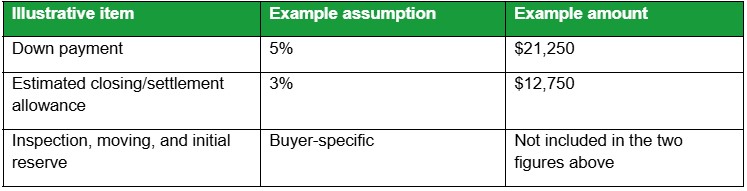 In this simplified example, the down payment and a 3% allowance total $34,000 before inspections, moving expenses, or the reserve you choose to keep. Actual loan terms and settlement costs can differ substantially, so obtain a current Loan Estimate and a property-specific cash-to-close figure from your lender.
Why a Generic Charlotte Income Number Can Mislead You
Articles often try to match a home price to one household-income figure. That shortcut leaves out too much. Two households earning the same amount can have very different buying power because of debt, credit, interest rate, down payment, insurance, taxes, HOA dues, and the loan program used.
Instead of relying on a broad income range, ask the lender to show several scenarios. Compare different purchase prices and down payments, and request the complete estimated monthly payment for each one. Then test those payments against your own budget before deciding where to shop.
Do not overlook rate changes. A payment estimate prepared weeks ago may no longer reflect the financing available when you make an offer. Reconfirm the numbers as your search progresses.
Budget for the Property, Not Just the Neighborhood
The same purchase price can lead to very different ownership costs. Before committing, review the expenses connected to the specific property:
- Current property-tax information and whether a recent reassessment or ownership change could affect future bills
- Homeowners, flood, wind, or other insurance considerations for the address
- HOA or condominium dues, planned increases, reserves, and possible special assessments
- Age and condition of the roof, HVAC, water heater, appliances, windows, and major systems
- Utility history and the cost of maintaining the lot, pool, exterior, or private systems
- Known repairs, renovation priorities, and items that may not be covered by the seller
Ways Buyers May Reduce the Cash Needed at Closing
Lower-down-payment financing
Some conventional, FHA, VA, USDA, and other programs may permit qualified buyers to purchase with less cash down. Eligibility, property requirements, mortgage insurance, and total cost vary.
Down-payment or closing-cost assistance
Some buyers may qualify for local, state, employer, or lender programs. Funding and requirements can change, so verify current availability with a knowledgeable lender or housing counselor.
Seller-paid closing costs
Depending on the property, market conditions, loan rules, and the strength of the overall offer, a seller may agree to contribute toward permitted buyer costs. This is a negotiated term, not an automatic benefit.
Builder incentives
New-construction builders may offer financing or closing incentives, sometimes tied to a preferred lender or closing provider. Compare the incentive with the complete loan terms and the price of the home rather than judging the incentive by its headline value.
A better credit and debt position
Improving credit, reducing monthly debt, or waiting until cash reserves are stronger may improve the available financing or make the eventual payment more manageable.
Do Not Spend Your Entire Approved Amount
A lender’s maximum is a financing boundary, not a recommendation. Leave room for repairs, tax or insurance changes, HOA increases, and the normal expenses that come with living in the home.
This matters especially when comparing an older home with deferred maintenance to a newer home with higher HOA dues, or a condominium with lower exterior maintenance but possible assessments. The less expensive home on paper is not always the less expensive home to own.
A careful budget gives you negotiating discipline. It helps you decide when a property is worth pursuing and when the price, terms, or future costs no longer make sense.
Representation Is Part of the Financial Plan
Before you share your maximum budget or negotiating priorities, know who the agent represents. The listing agent’s duty is to the seller. A buyer needs advice focused on the buyer’s price, terms, inspections, financing risk, and long-term ownership concerns.
Carolina Buyer’s Agent represents one side of the transaction: yours. Our firm policy is not to practice dual or designated agency. When we represent a buyer, the search, evaluation, offer strategy, inspection planning, and negotiation are centered on that buyer’s interests.
Julie Tuggle founded Carolina Buyer’s Agent after working in a traditional brokerage and seeing the need for representation built around the buyer’s side of the transaction. That one-side-only principle remains the foundation of the firm’s work.
A useful first meeting should answer three separate questions: What can the lender approve? What monthly payment fits your life? What type of home can you responsibly own within that payment?
A Better Way to Prepare Before You Shop
- Choose a monthly payment range that works with your full household budget.
- Ask a lender for a documented preapproval and several payment scenarios.
- Set aside funds for closing, inspections, moving, and post-closing reserves.
- Decide which recurring ownership costs you are willing to accept.
- Choose your buyer representation before discussing confidential financial limits or offer strategy.
- Update the financial figures when rates, property taxes, insurance, or the target home changes.
So, How Much Do You Need?
There is no single Charlotte budget that fits every buyer. The right amount is the combination of cash to close, a sustainable monthly payment, and enough reserves to own the home without immediate financial strain.
Start with your finances, then connect those numbers to the actual homes and neighborhoods available. That order protects you from shopping too high, overlooking ownership costs, or using all of your savings simply to reach the closing table.
Carolina Buyer’s Agent helps Charlotte-area buyers evaluate homes, neighborhoods, contract terms, and ownership costs with one-side-only representation. The goal is not to push you toward the highest price you can qualify for. It is to help you make a well-informed purchase that fits your priorities.
Carolina Buyer’s Agent | Charlotte, North Carolina | 704-366-0542
FAQs
Do I need 20% down to buy a home in Charlotte?
Not necessarily. Several loan programs may allow qualified buyers to purchase with less than 20% down. The best option depends on eligibility, mortgage insurance, available cash, and the total monthly payment.
Are closing costs separate from the down payment?
Yes. Buyers should normally plan for both. Closing costs can include lender, appraisal, attorney, title, prepaid tax and insurance, and other transaction expenses. Ask your lender for a current, personalized estimate.
How much emergency savings should I keep after closing?
There is no universal amount. The appropriate reserve depends on your income stability, the condition of the property, deductible levels, recurring obligations, and comfort with risk. Avoid using every available dollar to complete the purchase.
Should I get preapproved before looking at homes?
Yes. A documented preapproval helps define the financing range and identifies issues that may need attention. It should be paired with your personal monthly-payment limit, which may be lower than the lender maximum.
Can a seller help pay my closing costs?
Sometimes. Seller contributions depend on loan limits, market conditions, the property, and the full offer. They must be negotiated and should not be assumed before the seller agrees.
Why does buyer representation matter when setting a budget?
The listing agent represents the seller. A buyer representative can help you evaluate the complete cost of a property, structure an offer, review inspection and financing risks, and keep the negotiation focused on your interests.